

Why the best teams know which layer to hand to AI and which layer has to be right
What you can accomplish with coding agents right now is truly unbelievable. A year ago, you would have said a vibe coding app is kind of cute. But the ability of coding agents to build enterprise-ready applications is growing every day, and most people expect that to fully work in 3 or 4 years. I think it will happen in the next 12 months.
I am all in on this shift. Our team uses it. Our platform is being built faster because of it. The teams I respect most are shipping things in weeks that would have taken quarters. That is real, and it is only accelerating.
So when I talk about vibecoding compliance, I am not throwing cold water on AI. I am pointing at the one HR ops layer where getting it wrong has a specific kind of (dire) consequence, and helping people understand why that layer is different before they find out the hard way.
Where Vibecoding Works in HR Ops
Most of HR operations is fair game for vibecoded solutions.
A status dashboard? Build it today. An internal tracker for open requisitions? Done by Friday. A reminder workflow that fires when a background check clears? Go. A reporting view that pulls from your ATS and formats it for your leadership team? Absolutely.
These are the projects that used to require multi-week/month engineering commitments.Now they are weeklong projects. The power of AI coding agents has changed the math around what an ops team can build without a dedicated engineering team, and that is a genuine competitive advantage for companies leaning into it.
The reason this works in most of HR ops is that these workflows are forgiving. If the dashboard has a bug, you catch it and fix it. If the reminder fires on the wrong day, someone notices. The cost of a mistake is low and the feedback loop is fast. That is the right environment for moving quickly.
Why Employment Compliance Plays by Different Rules
Employment compliance is not that environment.
I-9 verification, E-Verify, WOTC, background check adverse action, and state and local tax forms are set by law. They vary by worker classification, state, industry, and client. The steps are not flexible. They are not negotiable.You either comply or you don't.
That distinction matters because it changes what it means to build correctly. A workflow that routes approvals can be debugged after it ships. A workflow that determines whether a worker's I-9 was completed inside the three-business-day window, or whether an E-Verify case gets referred for further action, or whether a WOTC certification was submitted within the 28-day deadline: that workflow is either compliant or it isn't. There is no "close enough."
This is not a workflow problem; it’s a domain knowledge problem. The logic that governs these processes took years to encode correctly because the regulations themselves are layered, change by jurisdiction, and have edge cases that expose you to the same liability as any other “common” case.
What AI-Native Compliance Actually Changes
The answer is not to avoid AI in compliance. It is about using AI within a system that already knows the domain.
There is a real difference between AI that generates compliance logic on the fly and AI that operates on top of compliance logic already encoded correctly. The first is fast and fragile. The second is fast and defensible.
When the domain knowledge is already in the system, AI can do the work ops teams spend their days on: assembling the right workflow for this worker in this state with this client's requirements, routing exceptions to the right person, drafting notices, tracking status across five systems, closing the loops that fall through the cracks. That is where AI in HR ops actually moves the needle. Not because it is generating logic, but because it is executing logic that has already been built right.
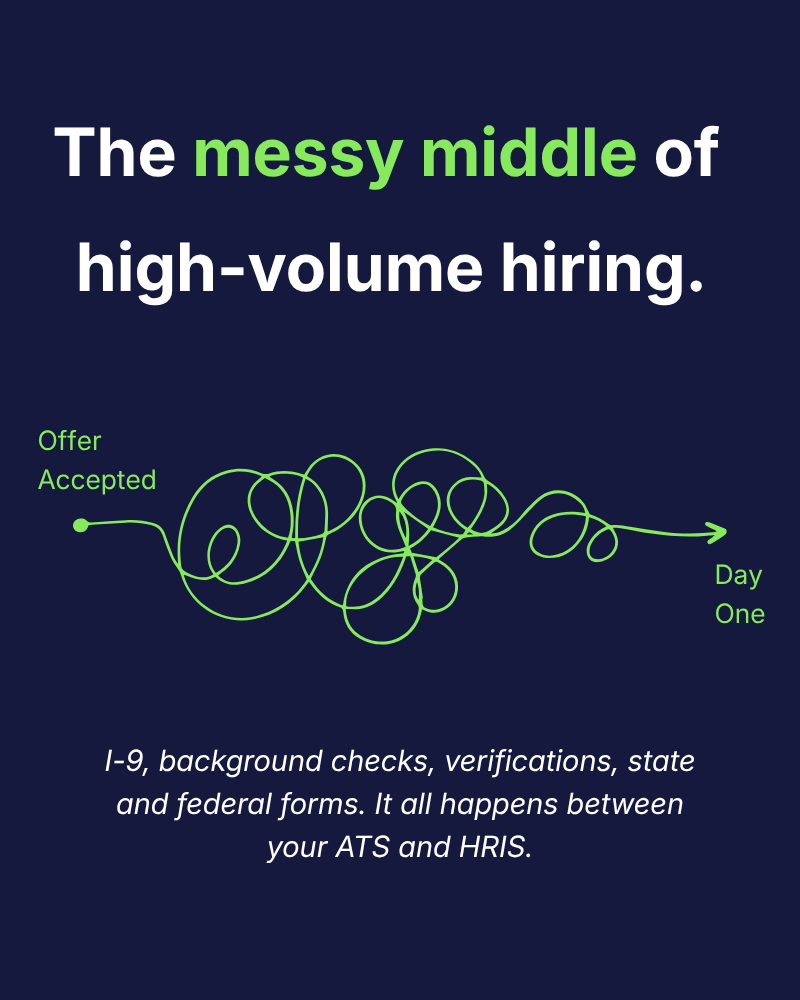
That is what we built at Onboarded. An AI-native employment compliance platform for the messy middle between the ATS and the HRIS, designed by people who spent years inside this space, built so the compliance runs by design and the ops team handles what actually needs judgment.
The Teams Moving Fastest Are Choosing Thoughtfully
The teams I see winning right now are not treating every workflow the same way. They are moving fast where fast is safe, and they are running on real infrastructure where real infrastructure is required. That’s the magic formula.
Vibecode the dashboard, the email writer, the internal tool that saves your ops team two hours a week.
But don’t ask an AI-generated workflow to become your compliance infrastructure. The cost of getting it right is building it once on a system that already knows the domain. The cost of getting it wrong shows up three months later in an audit, a missed deadline, or a worker who wasn't supposed to start but did.
If you are the person at your company who has been rigging workarounds to make employment compliance work at scale, and if you have been watching what AI can do and wondering whether to build this yourself or run it on something built for this: this one is for you.
FAQ
Can you use AI to automate employment compliance workflows?
Yes, and the best compliance platforms do exactly this. The critical distinction is whether the AI is generating compliance logic from scratch or executing logic that has already been built correctly by people with deep regulatory expertise. AI operating inside a purpose-built compliance system moves fast and stays defensible. AI generating compliance logic on its own creates workflows that look fine until an audit.
What is vibecoding and why doesn't it work for HR compliance?
Vibecoding refers to using AI coding agents to generate apps, dashboards, and workflows quickly, often in hours rather than weeks. It works well for flexible, forgiving workflows where a bug can be caught and fixed fast. Employment compliance is different because the rules are set by law, vary by state and worker classification, and require audit trails, exception handling, and regulatory updates. A vibecoded compliance workflow will appear to work until the edge cases hit.
What happens if you build I-9 or E-Verify workflows with AI instead of purpose-built software?
The workflow will handle standard cases and look functional. The risk is in the cases that fall outside the template: Tentative Nonconfirmations, form version changes, state-specific disclosure requirements, multi-state workers, client-specific credentialing rules. These are exactly the cases that appear in audits. A generated workflow has no way to know what it doesn't know.
What is AI-native HR compliance software?
AI-native HR compliance software uses AI to automate the work ops teams do manually: assembling the right workflow for each worker, routing exceptions, tracking status, drafting notices, and closing loops across multiple systems. The difference from standard workflow automation is that the compliance logic underneath the AI has been built by domain experts, kept current as regulations change, and tested against real audits.
What is the difference between a compliance workflow and compliance infrastructure?
A compliance workflow moves workers through steps. Compliance infrastructure includes the regulatory logic that determines which steps apply, the version control that keeps forms current, the audit trail that makes documentation retrievable, the exception handling for cases that don't fit the standard path, and the monitoring that catches when something changes. You can vibecode the first. The second is what an audit actually evaluates.

"There is a real difference between AI that generates compliance logic on the fly and AI that operates on top of compliance logic already encoded correctly. The first is fast and fragile. The second is fast and defensible."
.png)

.png)