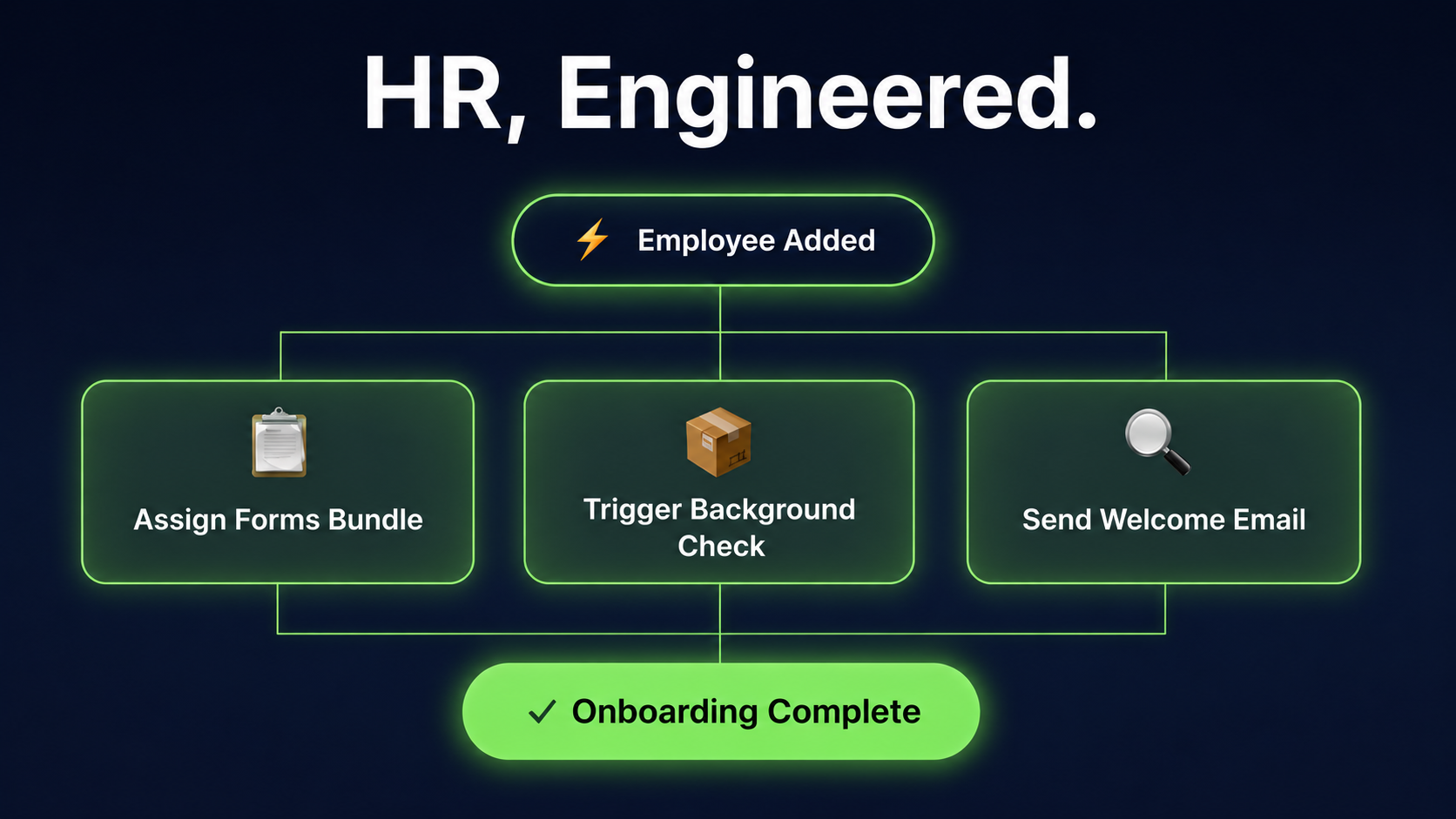
If you've ever figured out a workaround to get a worker activated, you're already engineering your HR operations.
Look around any high-performing ops team and you will find the same person.
Maybe they built the spreadsheet that pulls statuses from three systems and exposed real-time visibility nobody else had. Or they wired the Zap that fires the second an offer accepts. Or wrote the rule that routes I-9 exceptions one way and background check flags another. Or keep the state-by-state compliance logic current because they noticed the law moves faster than their tooling, so they built around it.
They are not patching a broken process, they are designing a new way of running the work.
This is HR Engineering and we explore it in depth in our latest guide. It's designing HR operations as a system rather than running them as a series of tasks. It's taking hold across operations leadership for an obvious reason: the term simply describes what the best ops people have always done. If you've ever figured out a workaround to get a worker compliant and ready to start, you are already practicing it. You are an HR Engineer.
Why the term matters
The shift from coordinating HR tasks to engineering a system is a structural change in how operations gets built, and the teams making the shift are pulling ahead.
In coordinated operations, people have to push the work through the process. In engineered operations, the system moves the work, and people handle the exceptions. Same job, two completely different outcomes. One scales with headcount, the other scales with design.
The reason this is becoming visible now is AI. Agents are now good enough to execute the routine layer: collect documents, send reminders, verify completion, route exceptions. That is the execution layer. What it needs is an architect, someone who decides which rules apply where, which client demands which step, which edge cases break the process, and what gets escalated versus handled.
That role is the HR Engineer. AI runs the routine. The HR Engineer decides what the system knows. The expertise compounds the longer you build, and it cannot be replicated by someone who hasn't done the work.
The four principles every HR Engineer builds toward
An engineered operation has four properties. If you've been pushing your team toward any of them, you are already in motion.
- Repeatable. The same steps run the same way every time, regardless of volume or who's on shift.
- Auditable. Every action is logged and defensible without anyone reconstructing it later.
- Context-aware. The system understands the difference between a healthcare contractor in California and a warehouse worker in Texas, and applies the right requirements to each automatically.
- Scalable. Volume can grow without ops headcount growing alongside it.
These are not aspirations. They are design choices, and the HR Engineer is the one who makes them.
What changes when you engineer instead of coordinate
Three things shift, and they all move in the same direction.
Your work compounds.
The hours you spent chasing documents become hours you spend designing workflows. What you build today still runs next quarter, and the quarter after that. That is leverage you cannot get from working harder.
Your role moves to strategic.
Instead of answering "is everything on track this week?", you are the person leadership asks "what should we build next?" Your value stops being measured by how much you processed and starts being measured by what you designed.
Your expertise becomes more valuable, not less.
Knowing which rules apply where, which clients need what, which states change requirements every quarter, that knowledge becomes the asset. Encoding it into the system is how it scales. The longer you do it, the harder you are to replace.
HR Engineering sits at the intersection of domain knowledge and systems thinking. That intersection is getting more valuable every year, and very few people are standing in it yet. The ones who get there first own the next decade of HR operations.
How to start
Worker activation is almost always the right first process to engineer. It is the highest-volume, highest-leverage, most measurable workflow in any ops function, and the gains are immediate and observable.
Read more on how to make the shift: the vocabulary, the four-principle framework, an assessment, three real scenarios from staffing, healthcare, and enterprise, and a five-step starter playbook you can run with your team this quarter.
➤ Onboarded's Definitive Guide to HR Engineering
Where Onboarded fits
Onboarded is the System of Action for HR Engineering. The platform models your workforce, assembles workflows automatically from context, uses AI agents to execute routine steps, enforces compliance as work runs, and surfaces only the exceptions your team needs to handle.
We built the platform that orchestrates the work so ops teams can do the work without getting stuck in spreadsheets and Zaps. We are committed to advancing the discipline, growing the vocabulary, and making sure the people doing the work get recognized for it.