



Onboarded surfaces workforce fraud across the worker lifecycle.
We already orchestrate the workflow between recruiting and payroll, so we see the signals no single check can. When something doesn't add up, Onboarded flags it so your team can make the call.
One connected workflow for onboarding, compliance, and workforce risk.
One check at hire won't catch what comes after
Most fraud prevention tools run at a single moment: application, identity check, background check, or I-9. But workforce fraud does not move in a straight line. A worker can clear one step, change information before payroll, fail an I-9 requirement, submit banking details that do not belong to them, or return under a new identity at redeployment.
This is where a disconnected HR compliance stack breaks down.
Each vendor sees only its own slice of the worker record, making inconsistencies almost impossible to catch.
When tools don’t compare notes, your team becomes the fraud detection layer. At hiring volume, the riskiest profiles can hide in the noise.
Fraud gets more expensive to fix at every stage it slips through: payroll, a client site, or in an annual audit.
.gif)
Onboarded already sees the handoffs where fraud hides
Onboarded coordinates the messy middle between recruiting and payroll: identity verification, background checks, I-9 and E-Verify, forms, direct deposit, client requirements, and system handoffs. Because those steps already run through Onboarded, fraud prevention is not another tool bolted onto your stack.
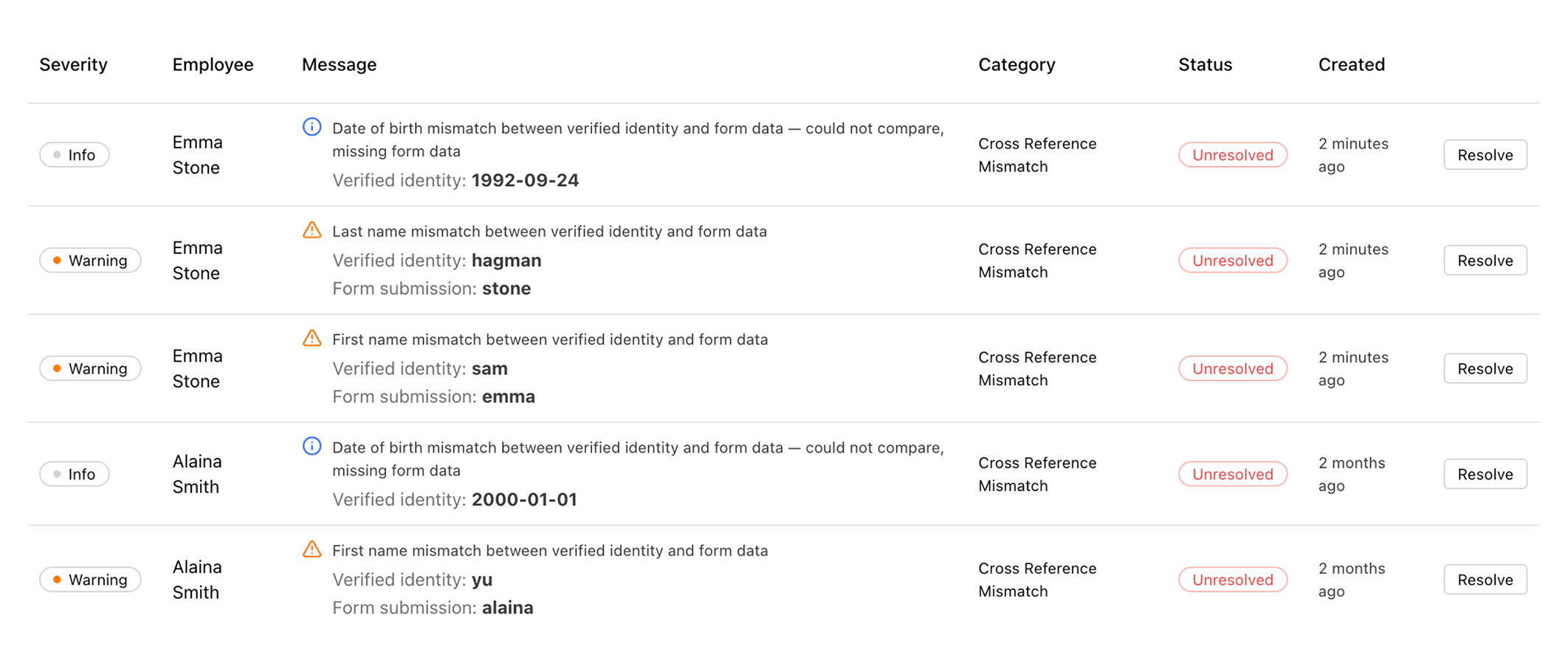
When data doesn't match, Onboarded surfaces it: a name that changes between stages, an SSN mismatch between intake and background check, a bank account reused across worker profiles, a document issue, an incomplete I-9, or a Day 1 check that does not match the person who onboarded.
No single signal proves fraud. Onboarded connects signals to make the risk visible.
We surface the signals. You make the call.
.avif)
Where fraud shows up in the hiring process and worker lifecycle
Workforce fraud is not one event. It can appear at different moments in the hiring and onboarding process, which is why a single gate at hire only catches part of the risk.
Built for teams where hiring volume turns small gaps into real exposure
Workforce Fraud Prevention FAQs
It's how hiring teams catch misrepresentation before it costs them: fake identities, altered documents, SSN mismatches, workers returning under a new name at redeployment. A single check at hire misses most of it because fraud doesn't stop at the application stage.
It connects signals across identity, background checks, I-9, and direct deposit. When something doesn't match across those sources, the worker profile gets flagged and your team sees the specific reason. You make the decision. Nothing is auto-rejected.
Before. Most teams do it the other way, then find out the identity the background check ran against doesn't match who actually showed up. Establish identity first, lock it, and run downstream checks against it. Sequencing matters more than most teams realize.
Most legitimate workers never see an extra step. Passive checks run in the background on data you're already collecting. A step-up check, like document verification or a selfie match, only triggers when a signal actually warrants it. Low friction by default, higher assurance when the risk calls for it.
Inconsistencies between what was submitted and what shows up: a name on the ID that reads differently on the bank record, duplicate applications sharing the same phone number or account details, a candidate who won't appear on camera, or a Day 1 arrival who doesn't match the person who interviewed. One of these is usually noise. Two or three together is worth a closer look.
No. It's a capability of the Onboarded platform, which already orchestrates onboarding and compliance between recruiting and payroll. Because identity, I-9, background checks, and direct deposit already run through the platform, the fraud signals come from work it's already doing. There's nothing extra to integrate.
No. Onboarded works with the vendors you already use and orchestrates across them.
Your team is alerted automatically and Onboarded can optionally pause that worker’s onboarding until their profile is reviewed. Nothing gets auto-approved or auto-rejected. A person reviews it and makes the call.
Every flag and the decision behind it is logged: who reviewed, what they saw, and what they did. If you're audited or face a compliance review, the trail is already there. You're not reconstructing it after the fact.