


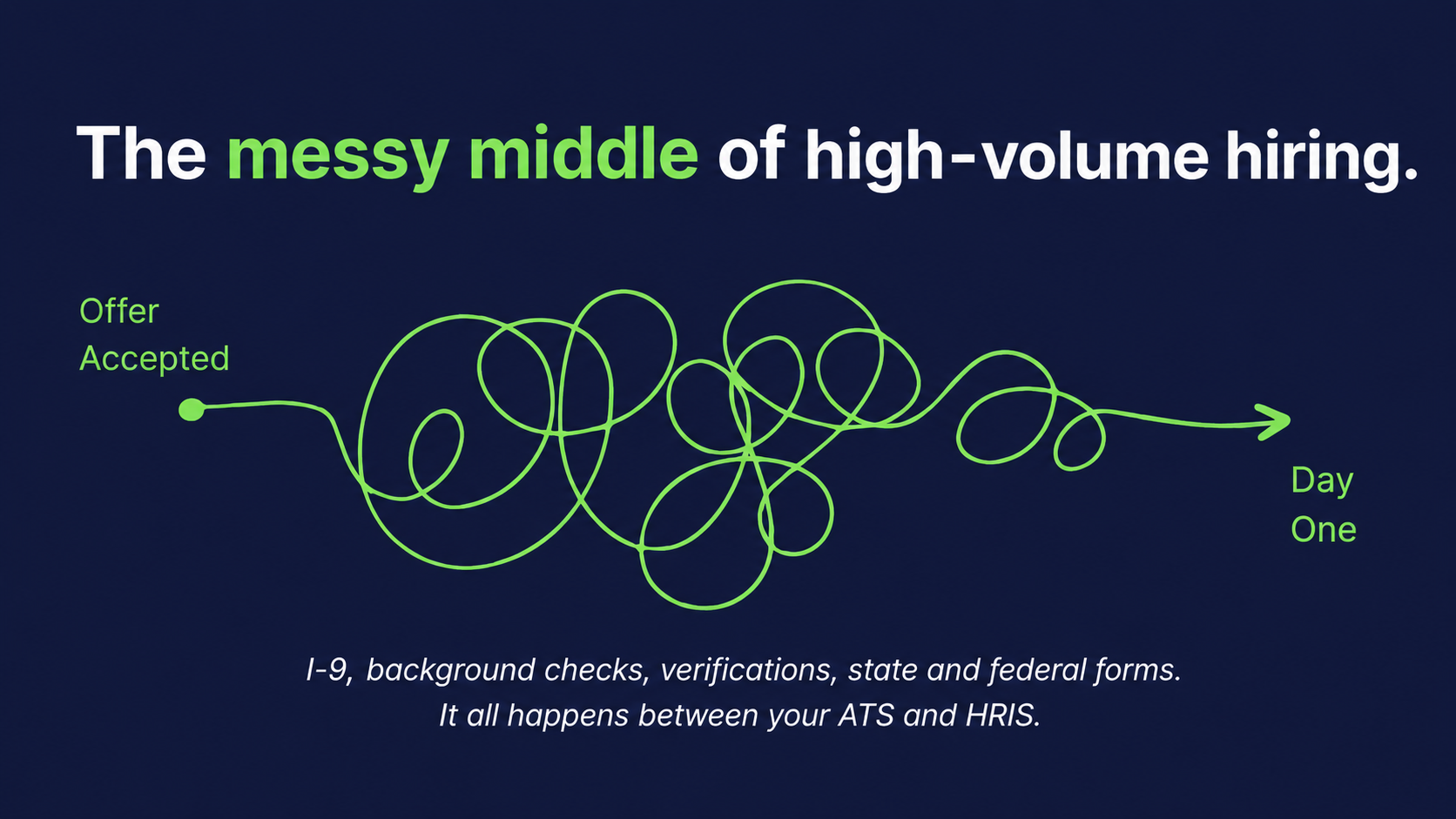
Staffing firms are great at sourcing workers but getting them to a first shift is a different challenge to solve. That gap between offer accepted and first shift worked is the messy middle, and it is where placements stall, margin compresses, and ops teams burn out.
The messy middle is where I-9s, E-Verify, background checks, drug screens, client-specific forms, credentialing, and policy acknowledgements pile up. It’s where ops teams spend their day chasing documents, manually pushing data between systems, and tracking status in inboxes and spreadsheets.
If you run high-volume hiring at a staffing firm, that gap is your single biggest controllable variable. One staffing firm went from 7% to 90% self-serve onboarding completion without adding headcount. The difference was not more people, it was a system that ran the work.
This blog looks at why the gap exists, why the systems you already own are not designed to fix it, and what to look for in something that can.
The Messy Middle, Defined
The messy middle is the onboarding work that happens between an offer accepted and Day 1 on the job.
Your ATS or CRM tracks candidates and stores the placement. Your HRIS or payroll system stores the worker record and runs payroll. Neither of them runs what happens in between.
That in-between work is real. For a single light-industrial placement at a multi-state staffing firm, it could include:
- Section 1 and Section 2 of the I-9, plus E-Verify
- A background check tied to the client's specific package, not yours
- WOTC screening before the offer is final
- State-specific tax withholding forms (federal W-4 plus all applicable state equivalents)
- Direct deposit forms
- Client-specific policies that change per assignment
- Site-specific safety certifications, sometimes with expiration dates that have to be tracked
A single placement can touch five+ systems and twenty or more documents that need to be manually tracked. Multiply that by the volume a mid-market staffing firm runs and the math is brutal.
Why Your ATS and HRIS Can't Close the Gap
ATS onboarding modules were built for low-variation hiring. One company, one workflow, light compliance. They handle a single I-9, a basic offer letter, a couple of forms. They were not built for staffing economics, where the worker is moving between clients, between states, between credentialing rules, sometimes between assignments in the same week.
HRIS onboarding modules were built to populate the system of record after the work is already done. They assume someone (you, your ops team) has already collected the documents, verified eligibility, and pushed the worker through compliance. They are a destination, not an engine.
Neither system understands worker context. The systems do not know that a CNA in Texas needs different paperwork than a CNA in California. They do not sequence the work. They do not enforce the rules. They do not run anything.
The result: your ops team becomes the workflow. They coordinate compliance and they spend their day being the integration layer between tools that were never designed to talk to each other.
What Actually Breaks in High-Volume Hiring
When the work falls on people instead of systems, four things break in predictable order.
1. Time to start stretches
Every manual handoff adds hours or days. Documents get emailed back and forth. Status lives in someone's inbox. A worker who should start Monday starts Wednesday, or Thursday, or never. For staffing, every day of delay is direct revenue loss. The placement only pays when the worker is on assignment.
2. Drop-off climbs
Workers abandon onboarding when it takes too long, requires too many logins, or needs a desktop. Every worker who drops between offer accepted and first shift worked is a placement that does not pay. Drop-off is not a candidate-quality problem, it’s often a process friction problem.
3. Compliance risk accumulates
When ops teams manually piece together I-9 documents, track E-Verify cases in spreadsheets, and email policy acknowledgements, the audit trail is whatever someone remembered to save. State mandates are tightening (Florida, Tennessee, Georgia, and Texas have all expanded E-Verify requirements in recent years), and federal scrutiny is increasing. Manual processes are a legal liability, not just an efficiency problem.
4. Ops teams stop doing ops work
Coordinators end up chasing documents, pushing data between systems, and tracking status in spreadsheets. The work that actually needs a human (exceptions, escalations, client-specific edge cases) gets squeezed out by the volume of mechanical handoffs no system runs. The fix is not fewer people. It’s giving the team their actual jobs back so judgment goes to the cases that need it and the system runs everything else. They become HR Engineers instead of task coordinators.
System of Record vs. System of Action
The clearest way to understand what's missing is the distinction between a system of record and a system of action.
A system of record stores information: an ATS stores candidates, an HRIS stores employees, a payroll system stores wage info. These systems are invaluable, but they are passive. They wait for someone to put data in and someone else to take data out.
A system of action runs the work. It knows what needs to happen, in what order, for which worker, under which rules. It executes by moving the work from one step to the next, applies the right requirements based on role, location, client, and worker type, and only escalates the things that need human judgment.
Most staffing firms today have several systems of record but no system of action. The system of action is their ops team. That's the gap.
What This Looks Like When It Works
Indeed Flex ran into this exact problem at scale. Before they rebuilt their stack, 7% of workers completed onboarding without human intervention. The other 93% required ops involvement somewhere in the flow.
After implementing Onboarded as the system of action between their ATS and their HRIS, self-serve completion jumped to 90%. The ops team's time shifted from coordinating documents to handling the cases that actually needed them. New client setup, the thing that used to take a week of configuration, dropped to less than a day.
The result is a structural shift in the economics of the business. Same team, dramatically more capacity, faster time to revenue per worker.
What Staffing Ops Leaders Should Look For
If you are evaluating how to fix this, the right question is not "what's the best onboarding tool." The right question is "what runs the work between my ATS and my HRIS." A few markers to look for:
- It should know the difference between assignments.
The same worker placed at two different clients usually needs two different sets of forms, policies, and credentials. The system should handle that without your team rebuilding the workflow each time.
- It should move work between tools, not just inside one.
When a background check clears, the next step should happen automatically. When a form is signed, the right system should get updated. Your team should not be the bridge between vendors.
- It has to work on a phone, in one tap.
One link, no app, no password. Anything that requires a desktop, a portal, or a login screen will fail your workers the day you launch it.
- Compliance should be part of the workflow, not a separate task.
The right forms, signatures, and approvals should be required as the worker moves through onboarding, with a complete audit trail captured along the way. You should not have to build an audit packet from scratch when a state shows up.
- It should fit into your existing stack, not try to replace it.
You already have an ATS, HRIS, background check vendor, and verification systems. If a vendor pitches you a rip-and-replace, they do not understand staffing.
Frequently Asked Questions
What is the messy middle in hiring?
The messy middle is the operational gap between offer accepted and first day worked. It includes I-9, E-Verify, background checks, drug screens, WOTC, state tax forms, policy acknowledgements, and client-specific requirements. ATS systems track candidates up to the offer. HRIS systems store the employee record after they start. Neither one runs the work in between.
What's the difference between an ATS and an onboarding orchestration platform?
An ATS (applicant tracking system) manages the candidate pipeline from sourcing through offer. It is a system of record for hiring. An onboarding orchestration platform runs the workflow between offer and start, executing compliance steps, routing data between systems, and getting the worker ready to be paid. The two are complementary, not competitive.
Why is high-volume hiring harder than standard hiring?
Standard hiring assumes one company, one rule set, one stable workflow. High-volume, high-complexity hiring breaks that immediately. Staffing firms place the same worker across dozens of clients in a year, each with its own compliance requirements, forms, and policies.
Manual steps that feel fine at 10 hires a month fall apart at 50, let alone 1000. Chasing documents, verifications, and credentials compound fast. The work scales but the team doesn't. That is how ops teams quietly become the workflow.
How do staffing firms reduce time to start?
The biggest lever is removing manual handoffs between the ATS, background check vendors, verification systems, and the HRIS or payroll system. Firms that orchestrate this work in a single system, with mobile-first worker flows and automated compliance enforcement, see time to start drop from days to hours and self-serve completion climb above 80%.
What does "system of action" mean?
A system of action is software that runs operational work, not just stores data. In hiring, a system of action assembles the right workflow for each worker based on role, location, client, and worker type, sequences the steps across multiple tools, enforces compliance rules in real time, and only escalates exceptions to humans. It is the opposite of a system of record, which waits passively for data to be entered and retrieved.
What is Onboarded?
Onboarded is the system of action for the messy middle of hiring. It runs the work between your ATS and your HRIS, orchestrating I-9, E-Verify, background checks, credentialing, and client-specific requirements automatically. Workers go from offer to first shift without manual coordination. Onboarded works with your existing HR tech stack and integrations.

.png)